Written by the lead designer Adam Španěl
Luck of Draw, Starting Deck & Starting Hand
As with any deckbuilding game, the starting deck went through a lot of iterations.
In Drillers, there are often turns where you want more movement, and other turns where you want more drills. That’s exactly why correctly using the mechanic of keeping cards is key for success–it allows you to plan ahead and shape your turns with intention.
The starting deck has several properties and purposes we had to take into account. It should be able to do something useful by itself, but still bought cards must feel significantly better than the starting cards, and ideally they should still feel relevant later in the game.
We iterated quite a bit with the fuel prices and effect strengths, and the ratio of drills and movement in the starting deck. We didn’t want any particular type of card to feel like a mandatory first pick. So the starting deck has in itself quite strong drilling power, but it is exceedingly fuel-demanding. You can drill even the toughest terrain, but the fuel cost is very high.
Size and Mix of Starting Deck
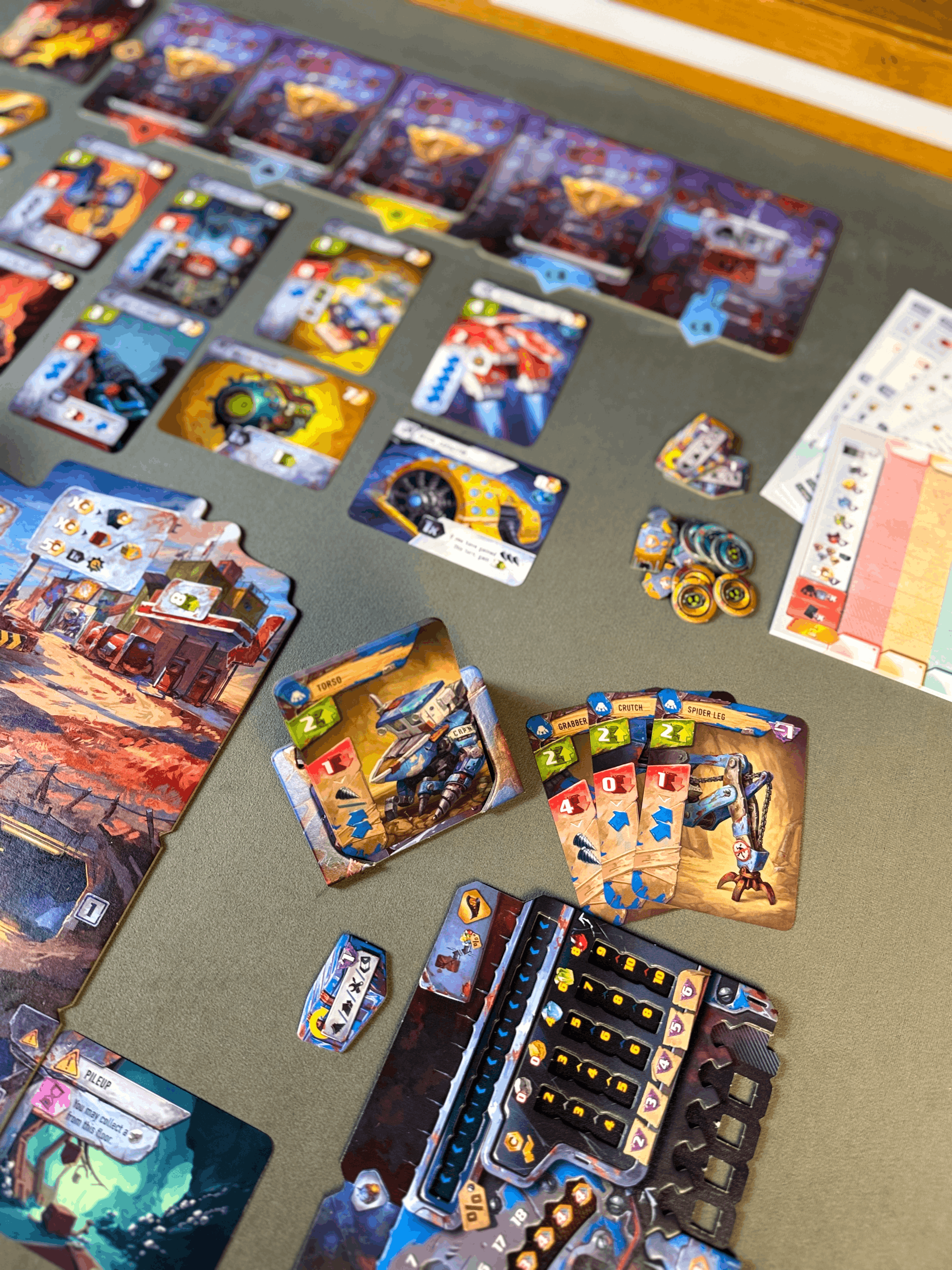
We also had to iterate quite a bit on the starting deck size.
It had to be thin, in order to make the deckbuilding aspect substantial enough, but still broad enough to include a mix of movement and drilling options. At the same time, the ratio of drills had to be high enough for the starting hand to make sure you can drill something in the first turn.
That’s why the Vintage Drill was printed: It gives you that little extra drilling power to make the start a bit faster, but thins your deck so you are more motivated to add new cards.
Planning vs Randomness
Drillers is a game where you find yourself wanting a specific kind of effect in a specific turn: drills when valuable minerals are available, move when you have full cargo or are on the surface, and repair when you have a damage in hand (and vice versa). Not having the right tools at the right time can be frustrating. A core mechanic of the game is keeping cards in hand, and it is precisely to mitigate these kinds of situations, and to plan ahead with what you see as your next card, and which cards you have left in the deck. Knowing which cards to keep, and when, is what separates good players from the best.
However, you cannot plan for your opening hand of the game.
We needed to make sure that no player starts the game with a turn where they can barely do anything, while others can play freely.
One of the solutions was cheap surface repair. Initially, it was set to cost 2 credits. So if you didn’t have a strong starting hand, you would just stay on the surface for the first turn, repair one of your bad cards, discard some cards for credits, and buy something for your next turn. However, it turned out that a winning strategy was to stay on the surface for the first 5 turns, repair everything for the 2 credits, and then fly off with a super thin deck.
So we had to make the repair a bit more expensive, especially at the start, which again made the weaker starting hands worse. We basically needed to make sure every starting hand is useful.
We tried a rule of mulligan, where before the start of the game you can draw a new hand. In practice, that was quite clumsy, and for first time players in particular, it was very confusing: they basically had to plan out their entire first turn, and then decide if they wanted to mulligan to possibly have an even better turn.
But then Elwen came with the great idea of always starting with the Torso card in the starting hand. It immediately worked flawlessly, and accomplished everything we needed.
Surface vs Digging
Early in development, there was the idea that diving and staying on the surface would be equally interesting options. Over time, it became clear that the situations where it is correct to stay on the surface are quite rare.
I am a bit sad to see this aspect go, but on the other hand, it makes the game a bit more approachable for beginners, and makes spotting the situations where it is beneficial to stay on the surface all the more satisfying.
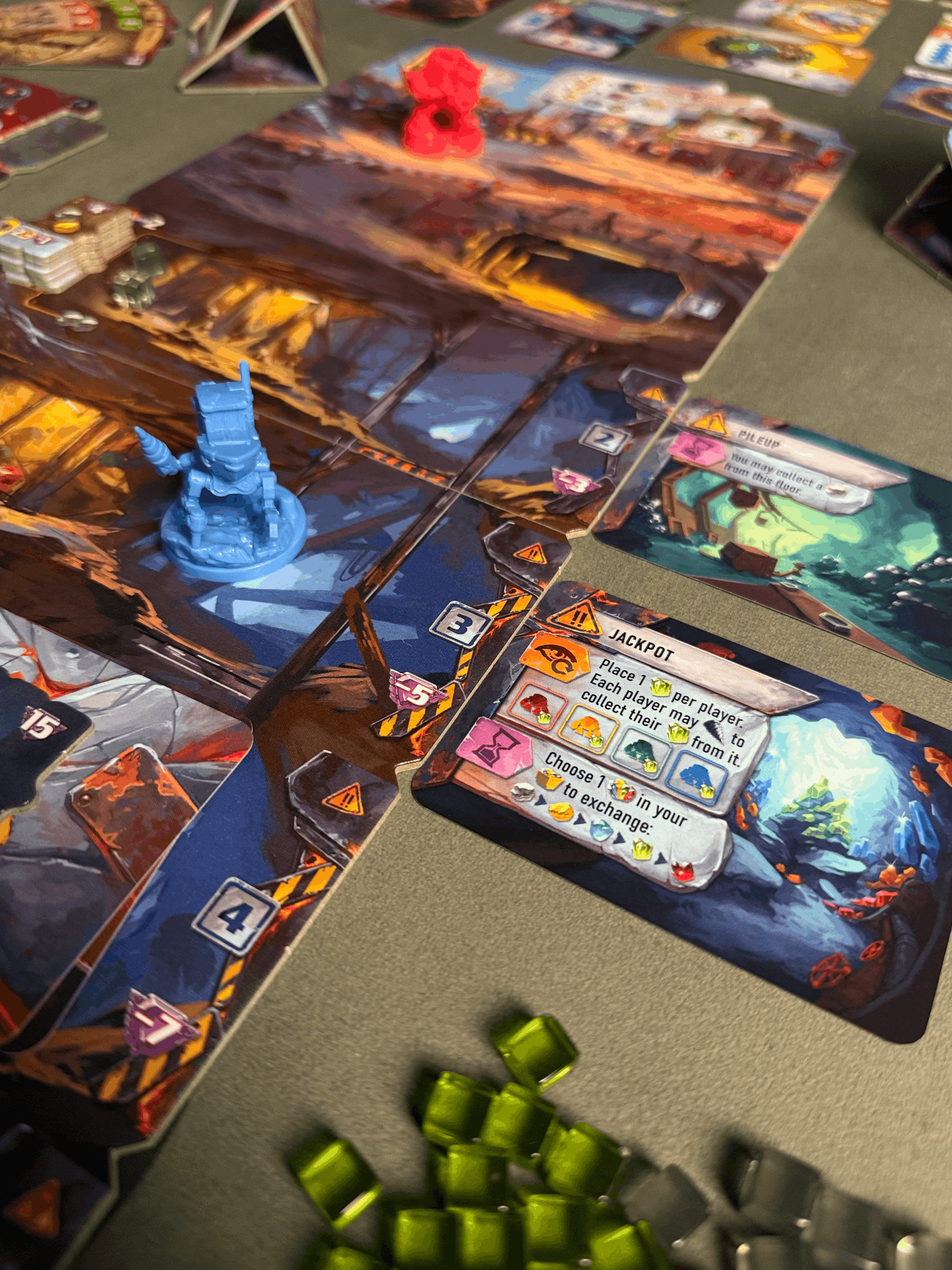
Damage Cards & Future Sight Mechanic
Initially, the damage cards were too punishing. They only provided 1 fuel, and that’s it. On top of that, they gave -4 points, and you could only repair them when they were in your hand. Unsurprisingly, you did everything you could to avoid them. In hindsight, it almost seems silly how bad they used to be.
We started by making small improvements–adding 1 extra fuel, then the option to pay fuel to draw a card. Of course, it was quite frustrating when the next card wasn’t all that useful for you.
So we decided to start testing the variant where you see the top card of the deck. There were 2 possible initial approaches: deck face down, and you can look at the card at any time. This was just clumsy. You want to see all your options. Just imagine having to hold your cards in one hand, looking at the top card with your other hand…well you didn’t have any hands left to actually play!
The other option was to always have your draw pile face up. But the drawbacks are obvious: you would confuse your draw pile and discard pile, and more importantly, players that pay attention can know your hand at any point in the game. This was a no-go for me.
So we started testing the card stands. They turned out great, and seeing the top card of the deck became one of the signature mechanics of the game–in the development we called it Future Sight. And this seems to be a theme, at least in my experience: a mechanic that turns out to be a core and unique thing is just a random idea that was there to solve a specific problem. It is always a great adventure, seeing where the design leads the designer!
The Shop
The shop had to check several boxes: be affordable in early game, be interesting in late game, and always offer something you want to pick up. We wanted to avoid the situations where you sell a bunch of gems, have a lot of credits, but end up burning them ineffectively on cards you don’t really feel great purchasing.
The first prototype had a single card row with all cards mixed together. In this system, there was quite a bit of luck involved, and too often, the situation was that you didn’t find the cards you needed, and the shop gradation throughout the game wasn’t really there. So I decided to add “stock” cards, similar to [gameid=201808] or many other deckbuilders. That worked reasonably well, but still, there was this aftertaste of not doing quite optimal turns.
Also, the idea of two tiers of cards started getting tested, with the higher tier appearing after reaching a certain floor.
All this culminated in how the shop works now: 3 basic types and the advanced cards.
Gradation and Timing
We have iterated quite a bit on how to add gradation to the advanced cards. We didn’t want to overwhelm the players with too big of an offer, but still needed to give them good enough selection for the late game.
A bit of influence of Clank! can be observed, where the card offer gradation is done masterfully. In one version, the advanced shop started with a single card, and each new floor added a new card. This was quite fiddly, so we arrived at the final solution where the shop is expanded once you reach the fourth floor. This made the shop dynamic enough, while not being so demanding for upkeep.
Shop Rotation
This was nice and all, but there was one last problem: the shop rotation. For a very long time, we didn’t have any shop rotation mechanics. The players testing the game repeatedly mentioned they would like to have a way to refresh the shop.
We added a token that allowed you to refresh the offer of a single shop once. It is one of those rules that is quite small, easy, and doesn’t add many components. However I was still a bit reluctant about it. Throughout development, I always want to keep the game clean, and avoid adding too many unnecessary mechanics.
In the end, I think this is one of those little mechanics that fits quite well and sometimes allows for smart plays. It turned out that just having the option was enough for most players, and incorporating it in a way that does not clutter the gameplay was best.
Drones
The drones underwent quite a bit of development.
The drones were not present at all in the initial prototypes. The gameplay loop was very tight in this regard, with little space for experimentation. Also, the effects of the cards were a bit bland, and a new effect was needed.
So the idea was an effect that would give you a little bit more sustain underground, and made staying a little longer more worthwhile. Selling one cube or buying one card was quite natural and intuitive.
Initially, the drones were instant, meaning you had to use them immediately when gaining them. This meant you had to hold onto certain cards until you could use them. While I insisted that it rewards good planning and keeping cards, after hearing the same feedback again and again, we finally decided to make the drones persistent.
Getting the balance of the drones right was also quite a challenge. It was like balancing on a knife’s edge: making them just a little bit too cheap tipped the scales enough to make camping at the bottom after buying a few drones the winning strategy. On the other hand, making them just a bit too expensive meant it was always better to just go to the surface.
We went through a few back-and-forth iterations, until we dialed it in just right.
We hope you enjoyed this part! Thank you all so much for the wonderful comments on Part 1 that we posted on BGG—we really appreciate the support. If you haven’t had the chance to read it, here is the link: Under the Surface: The Design Journey of Drillers PART 1
If you'd like to secure your copy of the game, we’ve just reopened pre-orders! This is your last chance to grab it before the official launch. Pre-orders will remain open until Monday, June 22nd.
cge-shop.com/drillers
To make sure you're notified the moment Part 3 drops next week, remember to subscribe to Drillers on BGG.